



MIT.SZ AI Summit
On December 14, the MIT.SZ AI Summit, hosted by the MIT Shenzhen Alumni Association and co-organized by MILES and other institutions, was successfully held at the Shenzhen Hetao Science and Technology Innovation Center. Distinguished experts and industry leaders from world-class universities, renowned enterprises and investment institutions gathered in Shenzhen, engaging in in-depth discussions on core topics including cutting-edge AI technologies, industrial applications and ecosystem construction, to explore the opportunities and challenges in the era of artificial intelligence.
The summit consisted of five thematic sessions: Cutting-edge AI Technologies, AI Empowering Science, AI and Robotics, AI Empowering Management, and AI and the Economy. It successfully facilitated cross-border sharing and diversified exchanges between leading AI experts, scholars and entrepreneurs from various fields, focusing on how to embrace opportunities and address challenges in the AI era.
1. Cutting-edge AI Technologies
In the “Cutting-edge Technologies” session, Armando Solar-Lezama, Professor at the MIT Department of Electrical Engineering and Computer Science (EECS) and Deputy Director & Chief Operating Officer of the MIT Computer Science and Artificial Intelligence Laboratory (CSAIL), delivered an online keynote speech titled “AI-Based Future Programming”, sharing in-depth insights into the cutting-edge breakthroughs and development trends of AI technologies. In the subsequent fireside chat, he interacted with Shaolun Huang (MIT Electrical Engineering PhD ’13), Associate Professor at Tsinghua Shenzhen International Graduate School, and answered questions from the audience.
Dahua Lin (MIT CS PhD ’12), Co-founder and Chief Scientist of SenseTime, then delivered a keynote report entitled “The Dual Variation of AI in 2025: Value Implementation and Spatial Thinking Leap”. He later joined a panel discussion with Lizhong Zheng, Viterbi Professor of EECS at MIT; Dafu Deng, Assistant General Manager of Tencent Games; Zidong Liu, Founder of Habitat Technology; and Rita Yuying Zhao (MIT Sloan MBA ’11), President of the MIT Shenzhen Alumni Association and Partner of HKX Qianhai Fund. The panel provided multi-perspective insights into the commercialization path of cutting-edge AI technologies from the dimensions of R&D, industrial implementation and scenario application.
2. AI Empowering Science
After the luncheon, guests visited and exchanged ideas at MILES, experiencing the vitality of the innovation ecosystem up close.
The afternoon session was equally brilliant. In “AI Empowering Science”, David Srolovitz, Dean of the Faculty of Engineering, Chair Professor of Mechanical Engineering at the University of Hong Kong and MILES Fellow, delivered a keynote speech titled “AI Empowering Science, AI Empowering Materials: From Fundamentals to Frontiers“.
He later joined a panel discussion with **Handi Xian**, Founding Partner & Chairman of GH Venture Capital and Chairman of the Hong Kong AI Funding Scheme Committee; **Hongjie Dai**, Chair Professor of Chemistry, Mechanical Engineering and Biomedical Engineering at the University of Hong Kong and President of MILES; and **Haojun Jia (MIT Chemistry PhD ’24)**, Founder and CEO of DeepOrigin. The panel explored the applications of AI in scientific research and its transformative impact on research paradigms and industrial deployment, offering new ideas for interdisciplinary innovation.
3. AI and Robotics
In the “AI and Robotics” session, Meng Xing (MIT Sloan MBA ’12), Partner at 5Y Capital, delivered a keynote speech titled “Embodied Intelligence: A View from the Rearview Mirror of Autonomous Driving”. In the subsequent panel discussion, he joined Gao Yuan (MIT Sloan MBA ’03), President of the MIT Shanghai Alumni Association and Partner at Pilotage Capital; Gui Zhaoyu (MIT Sloan Fellow ’07), Chairman & Founding Partner of Jingu Capital; Li Rui (MIT EECS PhD ’15), Founder and CEO of Weitai Robotics; and Fang Haoshu (MIT EECS Postdoc ’25), Assistant Professor at the University of Maryland. They focused on the integrated development of robotics and AI, discussing practical cases and future layouts in industrial and consumer sectors.
4. AI Empowering Management
Following the coffee break, the summit entered its second half of in-depth discussions. In “AI Empowering Management”, Jin Li (MIT Econ PhD ’07), Professor at the University of Hong Kong Business School and Director of CAMO, delivered a keynote speech ”The Great Compression: How AI Reshapes Skills, Motivation and Organizational Coordination", analyzing the transformative impact of AI on corporate management and organizational structure.
He later joined a discussion with Deng Rui (MIT Sloan ’15), Director, President & COO of Goldstar Holdings (Huizhou) Co., Ltd.; Huang Shan (MIT Sloan ’18), Assistant Professor at the University of Hong Kong Business School; and Jiaxin Pei & Ruyu Chen, Researchers at the Stanford Digital Economy Lab, exploring innovative management paths in the AI era.
5. AI and the Economy
The fireside chat for "AI and the Economy" was highly insightful. Shan Li (MIT Econ PhD ’94), Founder of Santu Technology, Founder of the Beijing International Institute of Wealth Management and Bauhinia Party, and Member of the National Committee of the Chinese People’s Political Consultative Conference (CPPCC), held an in-depth dialogue with host Chen Luyan (MIT MBA ’04), Co-founder and Partner of Kapok Capital, on the profound impact of AI on macroeconomics and industrial structure, presenting unique perspectives. During the Q&A session, Meijie Tang (MIT Material Sciences PhD ’95), Deputy Director of the Technology Transfer Office at the University of Hong Kong and Director of the MILES Technology Translation Center, raised the topic of "AI and Education". He pointed out that part of AI’s impact on the economy is essentially a transformation of the competency requirements for "people". As a core carrier of talent development, how education can leverage AI to achieve reform and meet the talent demands of future economic development is an urgent and important issue. This topic not only relates to individual career development and value realization, but also concerns a country’s future talent competitiveness and sustainable economic growth, adding practically meaningful extended thinking to the dialogue. With the closing remarks, the main agenda of the MIT.SZ AI Summit came to a successful conclusion. That evening, all participants gathered for a gala dinner, continuing their exchanges and renewing friendships in a relaxed and pleasant atmosphere, drawing a perfect end to the summit.
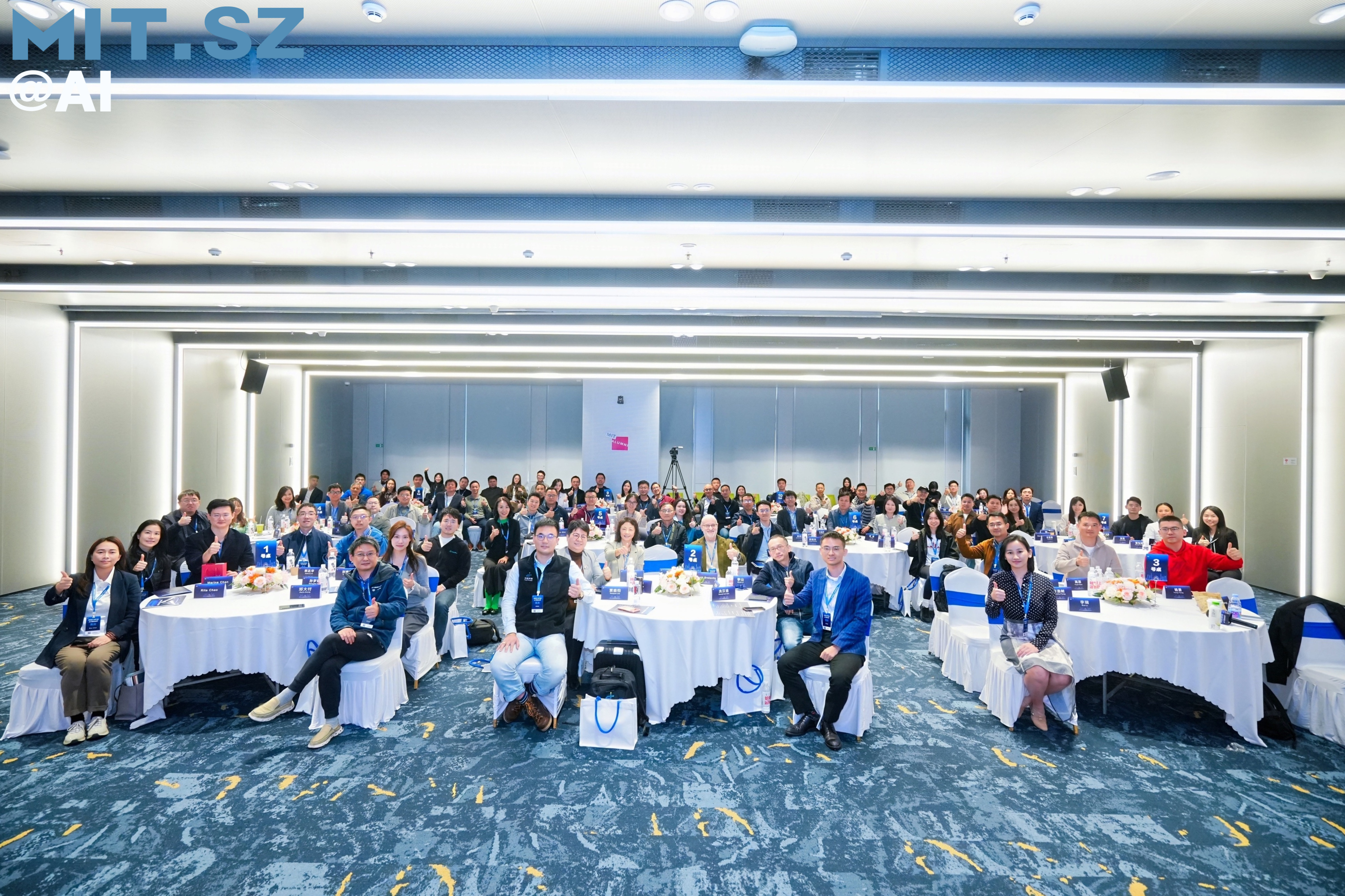
MILES is committed to building a platform for academic exchange and industrial cooperation in cutting-edge scientific fields, promoting the application and implementation of innovative technologies. By joining hands with the MIT Shenzhen Alumni Association and connecting institutions including the University of Hong Kong Business School, Tsinghua Shenzhen International Graduate School and Goldstar Technology Co., Ltd. to host the AI Summit, MILES has not only gathered top global intelligence in the AI sector, but also advanced the in-depth integration of industry, academia, research and application. In the future, MILES will continue to act as a bridge, build high-level exchange platforms, boost cutting-edge technological innovation and industrial upgrading, and work with colleagues from all sectors to write a new chapter of an AI-empowered future.
Please view the relevant WeChat article via this link: https://mp.weixin.qq.com/s/CMLdiPl5odKMIPL0uTZMig
